
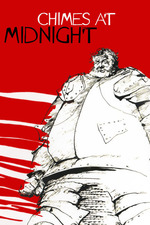


Welles's absolute, undeniable stage presence is on full display. He makes himself huge physically, visually, and emotionally, and then spends the entire film toppling himself, playing both roles of Jack and the giant. This is a film about a man full of bluster and bonhomie who, despite being superficially well-liked by all around him, continually pushes their tolerance to the breaking point, needling them, sapping their patience and their wallets even as he makes them laugh uproariously. Falstaff is good friends with all who meet him but never quite truly beloved by any, and when he finally acts upon presumption of that love he is utterly destroyed.
Knowing that Welles identified so personally with Falstaff, went to such great lengths to make this film happen, and even said that this role was his life's work makes its function as self-critique to the point of self-destruction all the more pointed. Fallstaff lies baldly and constantly, and we know from F for Fake that Welles saw his own role as a liar and charlatan; this film suggests that as much as those lies were an intrinsic part of himself, they were also a source of grief. Orson Welles, a man who always presented himself as larger than life, in this film where he is at his largest is also at his most exposed, raw, and vulnerable.