something I will say that has been very nice about
using RSS again... going back to reading "oldest
first" and having read/unread status. fight me
I've been surprised how many people I've seen posting about
how they're using RSS again. I guess even when
talking about "the heyday of RSS" I was assuming that it was
mostly more people joining and not using it than people
stopping that caused its decline. I for one have been using
RSS pretty much daily since the early 00s. My biggest
complaint with Cohost was not having a notion of a post being
"read"!
I guess I can grow and change but at my core there's still
that fourteen-year-old who's determined never to miss a
Dinosaur Comics.
I think most people stabilized their warped sense
of time by other means. Instead of accepting that
the pandemic continued on, that we failed to contain
it and so would need to incorporate its ongoing
reality into the stories we tell ourselves about our
own lives, they instead transformed the fantasy of after into their reality. After the pandemic, after the lockdowns, after
our world ruptured. They were able to interrupt the
prolonged uncertainty that the pandemic had brought
to all of our lives by erecting a finish line just
in time for them to run through it. And as they ran
through it, celebrating the fictional end of an
arduous journey, they simultaneously invented a new before. This is the invention of memory.
The Pandemic became something temporally contained,
its crisp boundaries providing a psychic safeguard to
any lingering anxieties around the vulnerability and
interdependence of our bodies that only a virus could
show us. No longer did it threaten to erupt in their
everyday lives, forcing cancellations and illnesses
and deaths. It was, officially, part of The Past. And
from the safety of hindsight (even if only an
illusion), people began telling and re-telling the
story of The Pandemic in ways that strayed from how it
all actually went down. It was a way to use memory as
self-soothing.
This is an intense, touching piece on the way people's minds
have been shaped by the pandemic, and the way that shape is in
turn determined by their—our—failure en masse to
handle the reality of the pandemic. It's another way of
looking at the same issues I was driving at in
COVID Denialism and Disability Justice, and I similarly found it helpful to bring myself some calm
(if not closure) to the pain of seeing people act so
heartlessly.
doing my level best to replace my "click over to
Cohost" instinct with "click over to my RSS reader"
instead of "click over to Mastodon"
#rss
#mastodon
it's actually really nice to take the time I'd normally spend
purposelessly[1]
browsing social media and spend it reading a blog post
instead. I read pretty slowly so it always takes some
dedicated time to get through anything longer than a few
paragraphs, and it feels good to actually dedicate that time
intentionally
I actually think that taking a few minutes to totally
context-switch your brain to something low-key and fun
before context-switching back to more serious work is
really valuable, at least for the way I work. It's like
giving my brain a quick rinse.
↩︎
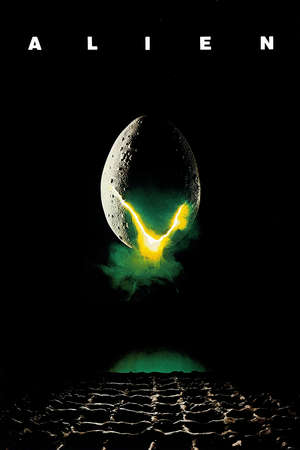
The film sets up a dichotomy between the inorganic—the
ship and its reactor filled with ornamentation we are
to assume is all for the realization of profit,
contrasted with its intensely human (and feline) crew.
The gorgeously-rendered hull of the ship acts as a
prison and its corridors restrict the possibilities of
its inhabitants. And yet, among the first thing we
hear from this crew is the seeds of organization, of
raging against their imprisonment.
But as soon as the film establishes this dichotomy, it
begins to play with it. The titular alien's nest is an
organic mockery of the ship, and once the xenomorph is
aboard the Nostromo it begins to cut (literally)
through the metal and plastic bonds, the hyperorganic
coming to dominate the machine. Eventually, the crew
itself begins taking action against the machine in
self-defense but from it and from their pursuer.
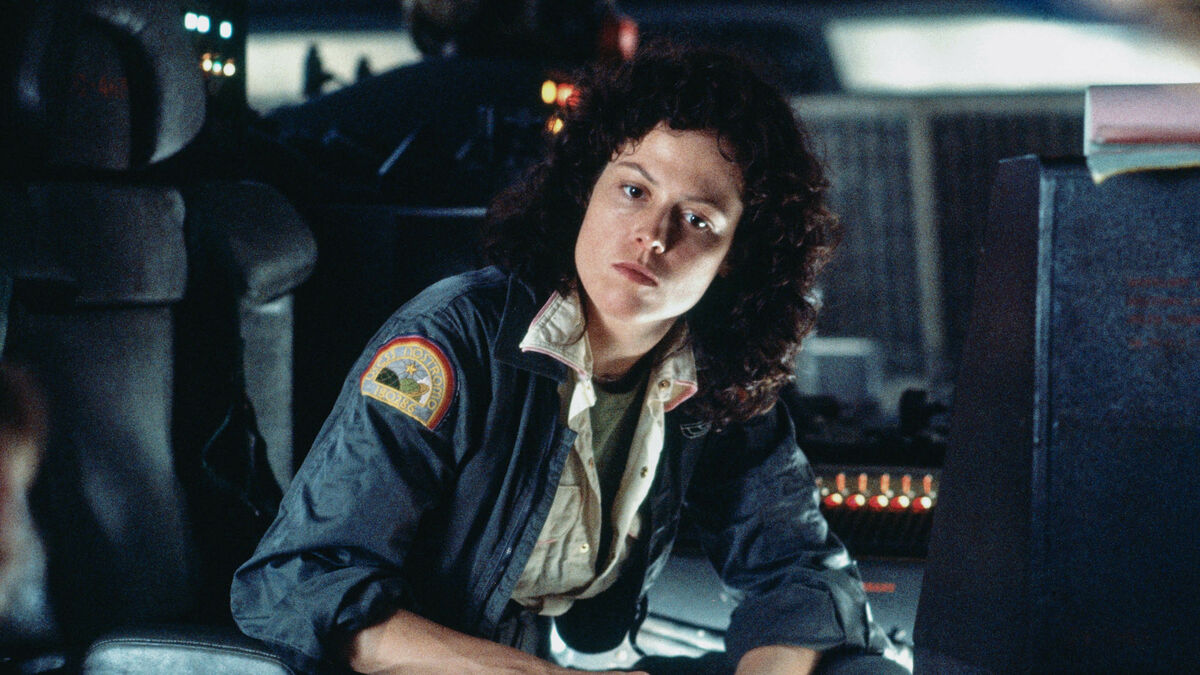
Ripley as a character becomes elaborated along with
this dichotomy. Although she's quiet at first, not one
of the crew who draws attention in the first few
scenes, the more we see from her the clearer her
values become. She holds life in the highest esteem,
even that of Jones the cat. In doing so, she stands in
opposition to the "purity" of force represented by
both the Nostromo and the xenomorph. In her, we see
that purity is intrinsically a false goal—the true
value is always in the impurities that make us people.
however. please 😮💨 at me if i am only ever posting
about computer or website. to lightly paraphrase
something a friend pointed out… the real tragedy of
october 1 is that a lot more of the people who i will
be seeing online in this way will be… computer
touchers. programmers. (although now that i say this:
it would be interesting to do a little audit of my
actual blogroll. because i can think of Several who
are not this.)
I'm really happy to see a bunch of the less-technical people I
followed on Cohost setting up blogs with
Bear or
Ghost or
WordPress. It's been fun
for me to set this site up as a playground for what could be
possible as far as bringing the aspects of social media I
value to the web, but truly one of the biggest virtues of
social media sites is making it so so easy to get set up and
start posting. At the same time, it's also one of its biggest
downfalls, because it's the same thing that makes it so easy
to get sucked into the quicksand of corporate lock-in.
Have you tried using serializd for reviewing and
logging TV Shows?
I actually do log what I watch there kind of sporadically.
It's all right! I wish it had a better app and were a bit more
like Letterboxd in general, but it's certainly better than
Trakt, its most direct competitor.
Part of the reason I don't use it is the lack of the app, but
part of it is also that it's a lot of effort to log
every single episode of anything I watch, but if I
only log season-by-season I'll often forget to log at all when
it comes to the finale.
The final nail in the coffin of using it the same way I do
other review apps is that I just don't have that much to say
about a single season of a television show. (I find I
have similar issues when I try to write reviews for manga
volumes.) There's often not that much different from the
season before or the season after, and I'll usually express
everything I have to say about the show in the first review or
two and then run out of steam.
As soon as
it was announced
that Cohost was shutting down, I knew I at least needed some
way to grieve it in community. I'm not a particularly
observant Jew, but I do take to heart the idea that grief is a
community experience. Cohost was never an experience of any
individual in isolation, so its loss shouldn't be experienced
in isolation either.
I talked to
my wife
and
Xandra
who had also made some rumblings about some sort of meet-up,
we decided on a place and time, and I sent out
an open invitation[1]. We knew Seattle was a pretty big Cohost city, but based on
the
Philly
and
Boston
turnouts we expected maybe thirty to forty people.
detailed image description
A large group of masked people in a park posing
together, many holding Eggbug plushes.
The last dedicated count we got was fifty-eight, but people
kept showing up after that so I believe in the end we had
more than sixty attendees.
Lydia
even came up from the Bay Area, shocking everyone there who
knew her! I was completely blown away by this incredible
outpouring of love for Cohost.
It was an intensely emotional mix of mourning and joy. We had
a moment of silence for the loss of Cohost, we came together
in a cheer of "Eggbug Forever!", but most of all people just
hung out and chatted. We even had our very own rainbow:
detailed image description
A photo of me, wearing a brown, navy, and tan knit
dress, posing jauntily while standing on a concrete
rise in Capitol Hill. A rainbow is visible over my
shoulder. Photo by rilight.
detailed image description
A blurry eggbug in the foreground gazes at a rainbow
as the sky darkens. Photo by Alyx.
Rose
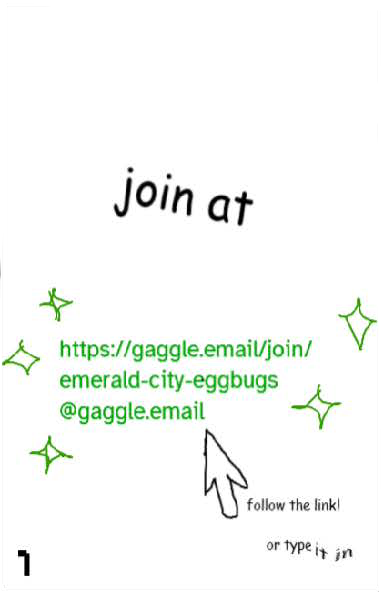
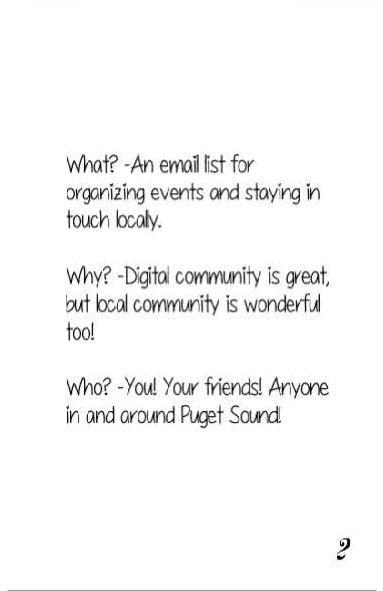
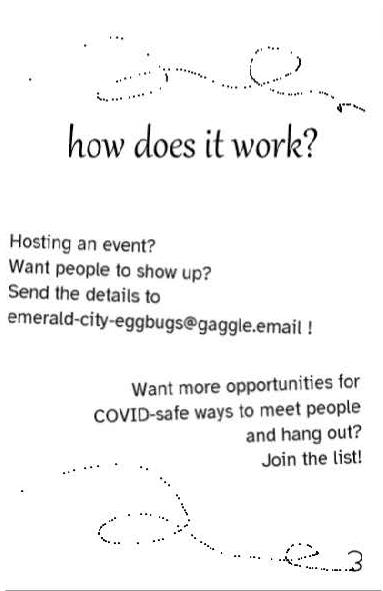
and I also came up with an idea for a little
local mailing list
for COVID-safe events. To help spread the word, we made a
zine. I only printed fifty copies, which I thought would be
plenty, so for anyone who showed up after all the
zines were gone or who couldn't make it at all, I've
reproduced it below:
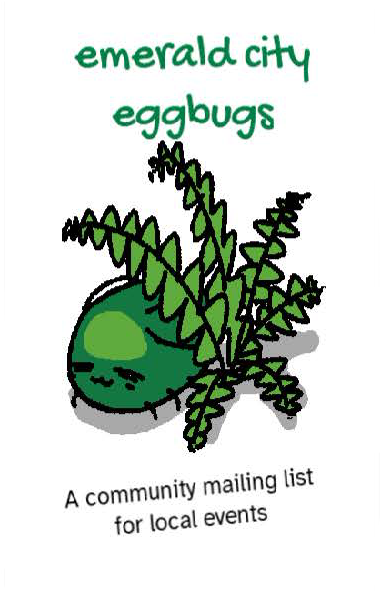
detailed image description
emerald city eggbugs
A community mailing list for local events.
(Between the text is a drawing of Eggbug resting
happily in the shade of a fern.)
one of my dear pleasures is seeing a person whom I'm not
particularly attracted to, but whom I can just
tell would make friends with different tastes
absolutely gnaw on the furniture with lust